Scholarly Retractions and Corrections Tool
Maintain the integrity of the scholarly record. Manage and deposit your metadata updates directly to Crossref.
About Scholarly Retractions and Corrections Tool
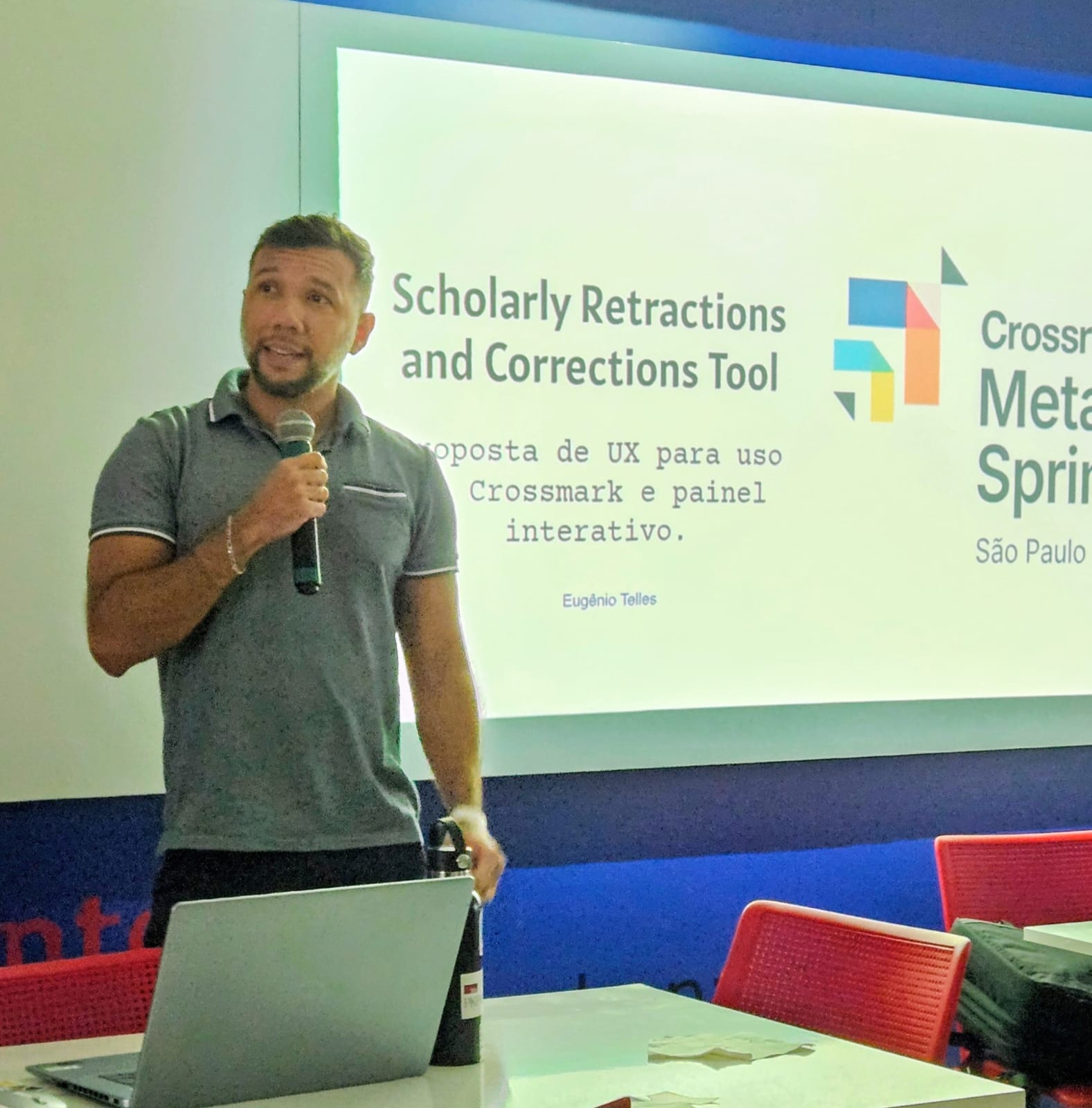
The Scholarly Retraction and Correction Tool (SRCT) was developed by Eugênio Telles (GeniusDesign, Crossref Sponsor Member) as a result of his participation in the Crossref Metadata Sprint São Paulo 2026 (March 4–6).
The initial motivation for the project was to create a solution that would make the Crossmark registration process—focused on retrieving update, correction, and retraction information for scholarly works—easier and more user-friendly. The idea was to design an application capable of generating the XML deposit file for Crossmark from a simple form that would retrieve existing metadata from a DOI record and enrich it with correction or retraction information provided by the user.
The dynamic interactions and exchange of experiences among participants at the Crossref Metadata Sprint enriched and expanded the project’s initial scope, adding features for global visualization of retractions and corrections and advanced search options.
How SRCT Works
1. Data visualization
Data collected from the Retraction Watch database—dedicated exclusively to retractions and integrated into Crossref’s metadata—is imported daily into a local database and displayed in the map and continental donut charts. This design choice was made to optimize data loading performance.
Data shown in the “Live Radar” are retrieved from the Crossref API every 60 seconds, displaying both retractions and corrections. Clicking on an item opens a modal window with detailed record information.
Since it integrates two data sources (Retraction Watch and the Crossref API), the platform offers two search forms: “Geographical Search”, which is essentially a set of filters by year, continent, and country for displaying Retraction Watch data; and “Keyword Search”, which retrieves retraction and correction records from the Crossref API based on a user-provided term.
The metrics displayed on the website are generated from the tool’s usage data and the imported data from Retraction Watch.
2. Forms
Two forms are available on the platform: one dedicated to retractions and another to corrections, each with its own specific fields.
Using a valid DOI provided by the user, SRCT queries the Crossref API to retrieve the corresponding metadata, displays it on the screen, and enables a form containing the specific fields for either retraction or correction.
Upon completion, the platform generates the XML file for Crossref deposit containing:
- Data for initial Crossmark registration
- The work’s title with the correction or retraction label (e.g., RETRACTION: [original_title] or CORRECTION: [original_title])
- Correction data and Crossmark history
The generated XML can be copied, downloaded, or deposited directly into Crossref. For direct deposit, the user must provide valid Crossref credentials. The XML file is submitted through a secure HTTPS cURL request, ensuring data protection during the transaction. No data generated by SRCT are stored, thus guaranteeing user privacy.
Example of generated XML
    <doi_batch xmlns="http://www.crossref.org/schema/4.4.2" xmlns:xsi="http://www.w3.org/2001/XMLSchema-instance" version="4.4.2" xsi:schemaLocation="http://www.crossref.org/schema/4.4.2 http://www.crossref.org/schemas/crossref4.4.2.xsd">"
        <head>
            <doi_batch_id>batch_update_20260306083506367</doi_batch_id>
            <timestamp>20260306083506367</timestamp>
            <depositor>
                <depositor_name>[name provided by user]</depositor_name>
                <email_address>[email provided by user]</email_address>
            </depositor>
            <registrant>Retractions Global Panel</registrant>
        </head>
        <body>
            <journal>
                <journal_metadata>
                    <full_title>[collected from object metadata]</full_title>
                    <issn>[collected from object metadata]</issn>
                </journal_metadata>
                <journal_article>
                    <titles>
                        <title>[addition - provided by user in the form]Correction Notice: [/addition][collected from object metadata]</title>
                    </titles>
                <publication_date>
                    <year>[collected from object metadata]</year>
                </publication_date>
                <doi_data>
                    <doi>[provided by user]</doi>
                    <resource>[provided by user]</resource>
                </doi_data>
                </journal_article>
                <journal_article>
                    <titles>
                        <title>[addition - provided by user in the form]CORRECTION: [/addition][collected from object metadata]</title>
                    </titles>
                    <publication_date>
                        <year>[collected from object metadata]</year>
                    </publication_date>
                    <crossmark>
                        <crossmark_policy>[provided by user]</crossmark_policy>
                        <crossmark_domains>
                            <crossmark_domain>
                                <domain>[collected from object metadata]</domain>
                            </crossmark_domain>
                        </crossmark_domains>
                        <crossmark_domain_exclusive>false</crossmark_domain_exclusive>
                        <updates>
                            <update type="correction[provided by user]" date="2026-03-06[provided by user]">[provided by user]</update>
                        </updates>
                        <custom_metadata>
                            <assertion name="scale_of_mistake" label="Scale of Mistake" group_name="publication_notes" group_label="Publication Notes">1 (out of 10)[provided by user]</assertion>
                            <assertion name="published" label="Published" group_name="publication_history" group_label="Publication History" order="0">2025-04-25[collected from object metadata]</assertion>
                            <assertion name="correction" label="Correction[provided by user]" group_name="publication_history" group_label="Publication History" order="1">2026-03-06[provided by user]</assertion>
                        </custom_metadata>
                    </crossmark>
                    <doi_data>
                        <doi>[original DOI collected from object metadata]</doi>
                        <resource>[original URL collected from object metadata]</resource>
                    </doi_data>
                </journal_article>
            </journal>
        </body>
    </doi_batch>
How to Use
No registration or Crossref credentials are required to use SRCT. Simply provide a valid DOI to use the forms and generate a Crossmark XML file, which can then be downloaded.
Development
SRCT was developed in vibe coding mode using Gemini Pro 3.0 via a web interface, with PHP and JavaScript for the codebase, MySQL for database management, and the UiKit framework for the user interface.
Free Software
The application’s source code is licensed by its creator, Eugênio Telles, under the GNU GPL 3.0, and is available in the project’s GitHub repository.
Privacy Policy
No user data, generated XML files, or Crossref credentials are stored, shared with third parties, or reused by the system. This website uses Google Analytics and Matomo tracking scripts to collect access and user behavior metrics for the purpose of improving user experience and performance.
Feedbacks
Feel free to share your feedback and suggestions for improvement on SRCT GitHub Discussions.
Acknowledgments
To Crossref, for the opportunity to collaborate and innovate alongside a diverse group of professionals.
Special thanks to:
- Edilson Damasio (UEM), for real-world validation testing and discussions on the academic retraction process;
- Nicolas Mejía Torres (Universidad de La Sabana), for initial insights during the project’s conception;
- Luis Montilla (Crossref, Technical Community Manager), for his support, coordination, and validation of the form design;
- Isaac Farley (Crossref, Head of Participation and Support), for his technical guidance and requirement validation;
- And all fellow participants of the Crossref Metadata Sprint São Paulo 2026, who contributed ideas and feedback throughout the three-day event (March 4–6).
About the creator
Eugênio Telles, a native of Rio de Janeiro, is the founder and CEO of GeniusDesign (a Crossref Sponsor Member). He is a specialist in Marketing and Digital Design (ESPM) and in Scientific and Technological Information (Fiocruz).